Showing posts with label Accelerator. Show all posts

Thursday, July 4, 2013

PFE030: The Higgs Mechanism Part 3 - The Discovery

The LHC is a pretty awesome machine. It took ten years to build the final component and uses five smaller accelerators to seed it. It is essentially the largest and most complex thing humans have ever built and the largest computing grid we've ever put together is employed to process the largest amount of data ever generated. It's also the largest refrigerator [okay, cryogenic facility but it's more fun to think about how much beer/potato salad would fit inside than super conducting magnets]. It also has reached the highest energy and luminosity in any man-made device ever. Whatever.

Kegs too.

I reiterate these things to emphasize how awesome of a machine it must be and how hard it must be to find whatever it's looking for.

While the Higgs field is everywhere and interacting with most things, it's hard to directly observe it. Luckily it has a side business creating additional particles, the Higgs boson. We can create, observe, measure, and quantify these particles - all those tasty things us physicists like doing. Unfortunately, it's not very good at making them. Lots of other boring particles [the kind of stuff we're made of and a zoo of other yawny stuff] are far easier to make. It's like looking for a needle in a haystack of haystacks [okay it's nothing like that because you or I could eventually suss out the needle and I have no idea how to even turn on an LHC - but it's really really hard].

Luckily, there are piles of physicists sorting out exactly how big the haystack is supposed to be. If it looks even teeny weeny bit [that's a technical term - move along] bigger than it's supposed to, then ta-da! We've got... something!

Just 365 short days ago [really they were all pretty average length days] on July 4, 2012 - it was announced that they had found something. It was definitely a boson, probably spin zero [remember that the Higgs is the only spin zero particle so far], and was consistent with the expected properties of the Higgs boson.

Put out the flag, grill some hot dogs, and call it a day, right?

If you look very closely you can see the SSC - the experiment that would have made this discovery an American one instead of a European one.

It's not done. We're not satisfied that easily. See, the predictions for this particle aren't just that they're a pain to make, but super specific. It should be this tall, this fast, this smart - it should have have these friends and hate those people. So on and so forth. But there are a bunch of crazy people who make things up [cough cough like me] who suspect it could be very slightly different. And to rule them out, or confirm their theories, they need measurements far more accurate than the general properties determined so far. Lot's more to do!

That's how you find a Higgs!

Spoiler alert: next week is both practical and not about particle physics!

PS - that isn't quite the end of the story. It appears that things could be rather more complicated than previously expected as indicated in my signoff. There may already be evidence of a second Higgs - don't go telling your friends or anything yet - but this is a key component of many popular theories whatever that means.

Saturday, June 15, 2013

PFE029: The Higgs Mechanism Part 2 - How It Acts

Last week, we heard about why we need the Higgs mechanism to fit in with everything else we know about little things. This week we are going to look at "how it interacts with stuff".

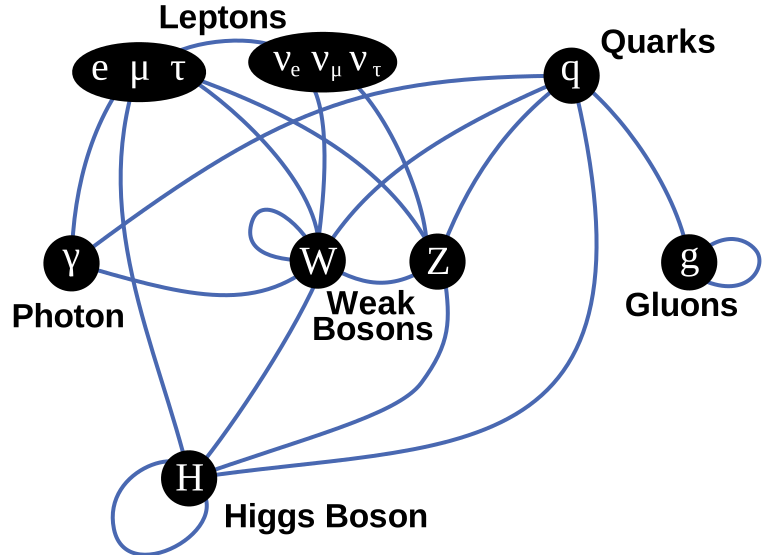
Personally I've always been a fan of this
graphic but whatever, it's super confusing. Let's start with the Higgs at the bottom. The line connecting it to itself means that it interacts with itself. The rest of the lines coming out of it means that it interacts with quarks, W and Z bosons [the weak bosons] and some of the leptons [in particular, the electron plus two others]. Notably absent from that list are gluons, photons, and those other leptons [neutrinos].

Okay, what?

It turns out that these are the particles that have mass. Of course, this is what was mentioned last week. Particles that have mass - a resistance to motion - interact with the Higgs. So the Higgs must somehow resist motion. Since the mass of a particle is proportional to how strongly it interacts with the Higgs, it appears that the Higgs itself, somehow, causes a resistance to motion.

Remember that pushing a monster truck is hard even in space with no gravity and no friction - that's because it still has a giant mass.

At this point people usually try to describe the Higgs as something like "sand that we are all moving through that slows us down - the heavier we are, the more we slow down". Of course this is a terrible description. Okay, not terrible, but still misleading.

The problem is that now everyone is thinking about aerodynamics - a frisbee flying in the regular fashion or flopping through this "Higgs sand" all sideways. But of course, that has nothing to do with it. The frisbee interacts with the Higgs field in the same way no matter how its moving.

Let's think of it a different way - in terms of what doesn't interact with the Higgs. Well there are gluons, but no one wants to have to think about those if they don't have to. There are neutrinos, but since the question of their mass is rather complicated and unclear, we'll ignore them too. Luckily, we still have photons or light - something that we are all familiar with!

Light particles don't interact with the Higgs - they may cross paths, but won't even notice it. What evidence of that do we see? They go at the speed of light!

"Wow, thanks there. Light goes at the speed of light? Great one. Now it all makes perfect sense."

Don't think of "the speed of light" as, well, "the speed of light" quite so much - think of it as the universal speed limit. The fastest that anything is allowed to go.
And since photons don't interact with the Higgs, they are always cruising along at a chill 669 million miles per hour.

But everything else [people and cars and toasters are made up of quarks and electrons] travels slower because they keep interacting with the Higgs field so much.

At this point its somewhat important to differentiate between the Higgs field and the Higgs boson. The field exists everywhere. It is here. It is there. It is in a box. It is in a fox. At any time and at any place, any particle that is allowed to interact with it [quarks, airplanes, electrons,... but not photons] does. This constant uniform behavior makes sure that all electrons have the same mass everywhere.

The boson - the particle - associated with all this nonsense, is a result of the fact that the field interacts with itself. A field doesn't have to do this, but because this one does, the Higgs boson itself has a mass.

That's how the Higgs acts.

Sunday, June 9, 2013

PFE028: The Higgs Mechanism Part 1 - The Need

Some of you may think that my recent hiatus was due to laziness, forgetfulness, boredness, etc. I have actually been waiting on CERN to write a post on the Higgs - I wanted to wait for it to reach discovery status. It is that time. This is the first in a three part series walking you through the need for the Higgs mechanism, what the Higgs mechanism is like, and the road to discovery.

There have been, recently, a few posts on the internet discussing the Higgs boson, the recent announcement from CERN, and what it all means. While many of them have stuck strictly to the facts many more [by my entirely unscientific count] have taken numerous liberties with said facts. Here at PFE you get the fair and balanced full story.

First, if you haven't already, go take a look at my last post on mass. Done?

Next, what are we talking about? Let's think about some vocabulary.

  1. Mass as discussed in this post will be that of inertial mass. Particle physics does not describe how gravity works [yet, we have some ideas though!]. Moreover, the mass of particles in question is so incredibly small that measuring their gravitational effects is overly tricky. As such the Higgs mechanism has nothing to do with gravity.
  2. The Standard Model is a collection of ideas put together over the 1960's and the 1970's, but the ideas themselves have been in progress for much longer. It describes everything we know about particle physics and unites three of the four forces [electromagnetic, strong, and weak - but not gravity]. It has been incredibly predictive and people are still working out all of the implications of the theories put together.
  3. "The God Particle" is a completely incorrect name often assigned to the Higgs boson. In 1993, Nobel laureate Leon Lederman wrote a book about, among other things, the Higgs boson. Apparently, he wanted to use the phrase "The Goddamn Particle" in the title due to the difficulty in tracking down the particle, but his publisher wouldn't let him. This name has led to a vastly increased media coverage distorting the facts. One popular myth goes along the lines of, "the particle is everywhere and interacts with everything so it is called 'The God Particle'". In fact, it does not interact with everything, and the particle is a consequence of a field that exists everywhere. There are multiple other fields [that which gives rise to light for instance] that exists everywhere.
  4. A boson is a classification of particles. All particles are either fermions or bosons. There are a few interesting properties and consequences of each, but they are not relevant for this Higgs discussion.
Before we get into the nitty-gritty details, I should first explain the history of the discovery. In particular, the name Higgs is associated with the man Dr. Peter Higgs

My namesake has some great moves as shown by the blurriness here.

but there were as many as six or more people who came up with the same idea at the same idea. While no Nobel prizes have been awarded on the subject, the Sakurai prize [some nerdy physics prize] was given to Higgs along with Kibble, Guralnik, Hagen, Englert, and Brout.

Enough physics history, that's even duller than physics itself, right?

Where does the Higgs mechanism fit in with everything else? As people were putting together the standard model, they kept awing themselves with the amazing predictions it made: cross sections, scattering angles, branching ratios, electric charges and magnetic moments among many more. But who cares about those? You all just read about mass, it's mass you want to know about. The thing is, there was no real way to sort out the mass of all of these particles. I know what you're thinking: "This great theory doesn't even tell you what mass the particles should have?" It looks like the theory is lost and we are nowhere.
A number of physicists [those six I mentioned above, plus a few others] put together a theory that allowed particles to have masses within the standard model. The problem is not just that particles need to acquire mass, but that they are all different. In a sense, before you add mass into the theory, all of the particles have a sort of symmetry in that they are all massless. But their masses had already been well-measured. Adding in something else to the theory allowed for an elegant means to allow for particles to have masses.

So this seems pretty straightforward - you don't have mass, so you add mass! But, alas, it's not. You can't just add stuff willy-nilly. I mean, you can of course. But see, the standard model is pretty much amazing. It is been heralded as the greatest scientific achievement. Ever. I mean, it was probably physicists making that claim, but still, pretty big. So if you just "add in mass" - which you can, you lose the beauty that is the standard model. So it has to be done carefully, it has to be done right. It has to be the Higgs.

The final note about the Higgs mechanism and the Higgs field that it describes, is that the field that allows for the mechanism to work "interacts with itself". Okay, that made no sense, but the effect is that you get the Higgs boson. Like how liquid water sort of condenses out of the air from gaseous form in some circumstances, a "condensate" of the Higgs field forms into a real particle just like the rest. It is through this particle that people hope to probe the nature of the Higgs field.

That's why we need the Higgs mechanism.

Friday, October 22, 2010

PFE014: LHC Part 2 - The Big Picture

Now that you know how the LHC works, I can talk a little bit about some of things happening there and explain some things you may have read in the media.

The LHC is at CERN. CERN is the European Organization for Nuclear Research and is in Geneva on the border between France and Switzerland (hence the misleading acronym). It has been a center for high energy physics research for some time. Recently the began work on the LHC, the large hadron collide. The fact that it's 17 miles should explain the large part. A hadron is a type of particle. There are so many different particles and so many classifications that it is often referred to as a particle zoo. Protons are hadrons (and the primary particle collided at the LHC). Collider should also be pretty clear, although it is interesting to note that there are 4 collision points in the LHC and that only a small fraction of the particles in the beams actually collide at these points.

On to the media. Google news gives 150 news stories for "god particle" in the last year alone including another one picked up by all the major news outlets just yesterday. This one irks me the most because it is entirely a media construction. The particle in question is the Higgs boson. The Higgs hasn't been seen even though it was first predicted some 45 years ago. The Higgs is supposed to be a way to describe how gravity works (yeah, we still don't really know how gravity works. I know, lame, right?) and since everything feels the gravity of everything else it is said, in some sense to be everywhere. So not only is the particle a sort of holy grail, a way to complete a nearly complete model that has been sitting for decades, but would also, in some sense, exists everywhere. Somewhere along the way a journalist misinterpreted a physicist comments and dubbed the particle the "god particle". Since the name is edgy in an article about science the media seems to love it, but it should be clear that the particle has nothing to do with any god of any sort. My main fear here is that if the LHC sees the Higgs, the papers are going to scream that physicists have proven god's existence with sections poorly explaining the actual physics.

The next media fiasco tied to the LHC is the fear that it will destroy the world (see here and here). There were several attempts to sue the United States government to shut down the LHC before it turned on (one such opinion can be found here (pdf)). Needless to say such claims are preposterous and baseless (you don't have to worry about the world ending from the LHC. 2012 is up to you though). Essentially the fears stem from a particularly bizarre theory taking off in a really unfortunate way (things like microscopic black holes or strange matter). On the one hand, there's no a priori reason to believe that these things can't happen. The Tevatron has been running for decades and nothing has happened. Not only has nothing happened, they haven't even glimpsed anything to suggest that something unheard of might occur. Maybe because the LHC will collide particles with 7 times as much energy these new phenomena will show up? Again, maybe. But particles with these energies (and higher) have been striking the earth's atmosphere forever and the earth is still here. While the frequencies are significantly lower than in a particle accelerator, these collisions do happen very regularly all the time and all around us.

Is this proof that the LHC won't destroy the world? No. It is very hard to prove that something won't happen. We can show that something has happened, or that something won't happen up to a certain probability. This is incredibly unsettling to some people. But our lives are ruled by random events. A random solar flare in just the right place can knock out half our satellites. No GPS, no satellite communications, in an instant. Or on a highway. The driver next to you can lose concentration and swerve into your car. These events, and their effects on us are probabilistic. We can plan for some eventualities, and put in place measures to limit these probabilities, but this doesn't mean that we shouldn't use cars or take advantage of satellites.

To be more precise on topics like these is impossible simply because no one understands them. If we did, we wouldn't need huge machines like the LHC to sort them all out.

That's the LHC.

Wednesday, October 20, 2010

PFE013: LHC Part 1 - The Basics

Over the last several years, the LHC has been in the news a lot. Enough to hit critical mass in the media. Apparently, when it comes to science that no one understands, this means that it's okay to write stories based on a bizarre theory someone came up with, write about it as though it's widely accepted, and then include a sentence at the end explaining that it hasn't been proven yet.

Before I talk about these things, I think an understanding of how such a monstrous machine works is helpful to keeping up with a large portion of physics in the news.

A particle accelerator may be used for a variety of different things. Accelerators like the LHC, the Tevatron, or SLAC are used to study basic physics. But accelerators like this account for a very small percentage of all accelerators. There are accelerators for manufacturing electronics, medical research, and medical treatment. Most of this post will focus on the higher energy physics based accelerators, but it all applies to medical, manufacturing accelerators too.

But we have all seen particle accelerators in our everyday lives. A battery is a device that accelerates electrons. It is doing essentially the same thing as the LHC! Just on a scale about nine trillion times smaller. So an accelerator is any mechanism that creates a stream of particles going very quickly (or, more usefully, with more energy).

Particle accelerators can be classified into two main types: circular accelerators, and linear accelerators. Each with its own advantages and disadvantages.

Circular accelerators have three main parts: magnets, rf-cavities, and detectors. Since the particles that are accelerated are charged, magnets are used to bend them in a circle. In fact, there are typically two beams of particles moving in opposite directions. A simple relation can be used to show that how strong the magnets need to be increases as the speed and energy of the particles increases and decreases as the size of the circle increases. Since more new physics can be seen at higher energies, and the limiting factor is often the size of the magnets, these machines can end up being as large as 17 miles around.

The next important part is the rf-cavities. The first thing to know is that magnets can't be used to make particles go faster, they can only change their direction. To get the particles going this fast, you need something else to accelerate them. And the methods used are similar to how microwaves work. The best way to imagine how an rf-cavity works is to think of surfing. The cavity creates waves of energy moving through a chamber, and, if the particles enter the cavity at just the right point on the wave, it will be pushed through the cavity and will get a touch more energy. The major advantage of circular accelerators is that  one rf-cavity can be used many times to accelerate a particle. So particles can gain as much energy as we want, up to infinity, right? Sadly, no. As the particles are bent around the circle, energy is lost. The more energy the particles have and the sharper the curve, the more energy is lost. So eventually the amount of energy lost will equal the amount of energy the cavity can add and the particle has reached its maximum energy.

The final part is the detector. There are a number of monitoring devices to keep track of where everything is. Now they use all kinds of fancy equipment, but a story passed down to me from the early days of accelerators was that to check if the particles were in the pipe, they would stick their head in and actually look. The particles would create a blue light inside their eyeball and they would know that the machine was working properly. The main detectors are where the particles collide. At these points on the ring, the magnets bend the two beams into each other and a bunch of massive collisions (hopefully) happen. Particles are sprayed out in all directions and huge detector measures what happens to all of them, before the next particles collide, an instant later. Then, computer software figures out what happened at the collision point.

A linear accelerator operates in largely the same fashion as a circular accelerator. As it turns out, the energy lost as particles are bent around in a circle is much more for some particles than others (it goes by m-4 for those interested). So for these sorts of particles (typically electrons) it is more efficient to line a bunch of rf-cavities and either smash two such beams or hit a stationary target. This takes more rf-cavities, but you don't need huge magnets to bend it in a circle and energy isn't lost from doing so.

I should emphasize that as much as I have covered here is only a small portion of the actual mechanics of particle accelerators. There are a number of topics that I glossed over (or simply ignored), so please ask to expand on anything that's confusing or unclear.

That's accelerators.