Sunday, July 14, 2013

PFE031: Thunderstorms

Thunderstorms are awesome am I right?


Lightning! Thunder! Rain [sometimes]! Pretty. Loud. Pretty LOUD!

So why am I looking to muck pretty awesome things up with numbers? Because, I don't know, it's you who's reading this, it's probably more of your fault anyways [see above image].

Right, so we're going to review a common and fairly well known trick: the five second rule.


Not that one, the one about lightning and thunder.

Lightning and thunder happen at basically the same time... at the location of the lightning. So if you get hit by lightning you'll see the flash and hear the thunder at the same time [or you won't because your brain will be rather well-done, I don't know]. But as you move away from the lightning [generally a good idea] everyone knows that the thunder slides away from the lightning too... in time. That is, you see a flash and then... BOOM.

Let's science this up now. Light goes fast. I mean, really fast. Count one second: "one one thousand". Light from the earth is basically to the moon in that time. So we can pretend that light's instantaneous for any distances on earth that we are ever going to care about.

Sound, on the other hand, is comparatively pokey. Since sound travels through something [air in this case] it is a little bit dependent on the properties of that material, but at 50F [a reasonable temperature for a thunderstorm I figured] sound travels at about 1107 feet per second. How fast is that? Well, let's see, it's certainly faster than I can run [thank goodness! Otherwise there would be sonic booms all the time]. If we then convert that into seconds per miles [which might seem like a weird unit unless you're a runner] we get about 4.77 seconds per mile - it takes sound just under five seconds to travel a mile.

BUT WAIT! THERE'S MORE!

So apparently sound travels faster when there's more humidity in the air. This is actually a little bit complicated, but a simple model gives about a half a percent increase. This brings our timing down to an even shorter 4.75 seconds per mile. Whatever.

This gives us our standard five second rule [unlike the food one above, this one is rooted in SCIENCE, YEAAA!!!]. Start counting time as soon as you see lightning and stop as soon as you hear the corresponding thunder [if the storm is too active it can be tough to tell which boom corresponds with which flash - you're on your own in these cases]. Take the number of seconds and divide by five [then round up a teensy bit if you want to be more accurate] and that will tell you how far away the lightning is. If you counted 8 seconds you're looking at ~1.6 miles away. Is it just that easy? It's just that easy.

But... who cares how far away it is? What we really care about is

Shh. I'm counting between the lightning and the thunder to see if the storm is coming or going.

whether the storm is coming, leaving, or passing us by. If we repeat the above process, we can get the distance to the strongest part of the storm over a period of time. If the distances are shrinking head for cover. Of course, you can also probably tell if the lightning is getting brighter and the thunder is getting louder and if it starts pouring on your poor unprotected head - but this way is way more fun.

That's thunderstorms.

Thursday, July 4, 2013

PFE030: The Higgs Mechanism Part 3 - The Discovery

The LHC is a pretty awesome machine. It took ten years to build the final component and uses five smaller accelerators to seed it. It is essentially the largest and most complex thing humans have ever built and the largest computing grid we've ever put together is employed to process the largest amount of data ever generated. It's also the largest refrigerator [okay, cryogenic facility but it's more fun to think about how much beer/potato salad would fit inside than super conducting magnets]. It also has reached the highest energy and luminosity in any man-made device ever. Whatever.

Kegs too.

I reiterate these things to emphasize how awesome of a machine it must be and how hard it must be to find whatever it's looking for.

While the Higgs field is everywhere and interacting with most things, it's hard to directly observe it. Luckily it has a side business creating additional particles, the Higgs boson. We can create, observe, measure, and quantify these particles - all those tasty things us physicists like doing. Unfortunately, it's not very good at making them. Lots of other boring particles [the kind of stuff we're made of and a zoo of other yawny stuff] are far easier to make. It's like looking for a needle in a haystack of haystacks [okay it's nothing like that because you or I could eventually suss out the needle and I have no idea how to even turn on an LHC - but it's really really hard].

Luckily, there are piles of physicists sorting out exactly how big the haystack is supposed to be. If it looks even teeny weeny bit [that's a technical term - move along] bigger than it's supposed to, then ta-da! We've got... something!

Just 365 short days ago [really they were all pretty average length days] on July 4, 2012 - it was announced that they had found something. It was definitely a boson, probably spin zero [remember that the Higgs is the only spin zero particle so far], and was consistent with the expected properties of the Higgs boson.

Put out the flag, grill some hot dogs, and call it a day, right?

If you look very closely you can see the SSC - the experiment that would have made this discovery an American one instead of a European one.

It's not done. We're not satisfied that easily. See, the predictions for this particle aren't just that they're a pain to make, but super specific. It should be this tall, this fast, this smart - it should have have these friends and hate those people. So on and so forth. But there are a bunch of crazy people who make things up [cough cough like me] who suspect it could be very slightly different. And to rule them out, or confirm their theories, they need measurements far more accurate than the general properties determined so far. Lot's more to do!

That's how you find a Higgs!

Spoiler alert: next week is both practical and not about particle physics!

PS - that isn't quite the end of the story. It appears that things could be rather more complicated than previously expected as indicated in my signoff. There may already be evidence of a second Higgs - don't go telling your friends or anything yet - but this is a key component of many popular theories whatever that means.

Saturday, June 15, 2013

PFE029: The Higgs Mechanism Part 2 - How It Acts

Last week, we heard about why we need the Higgs mechanism to fit in with everything else we know about little things. This week we are going to look at "how it interacts with stuff".

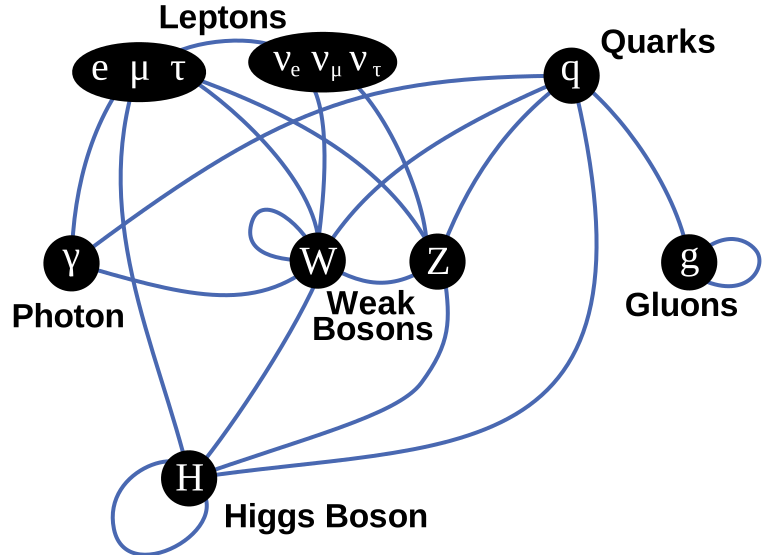
Personally I've always been a fan of this
graphic but whatever, it's super confusing. Let's start with the Higgs at the bottom. The line connecting it to itself means that it interacts with itself. The rest of the lines coming out of it means that it interacts with quarks, W and Z bosons [the weak bosons] and some of the leptons [in particular, the electron plus two others]. Notably absent from that list are gluons, photons, and those other leptons [neutrinos].

Okay, what?

It turns out that these are the particles that have mass. Of course, this is what was mentioned last week. Particles that have mass - a resistance to motion - interact with the Higgs. So the Higgs must somehow resist motion. Since the mass of a particle is proportional to how strongly it interacts with the Higgs, it appears that the Higgs itself, somehow, causes a resistance to motion.

Remember that pushing a monster truck is hard even in space with no gravity and no friction - that's because it still has a giant mass.

At this point people usually try to describe the Higgs as something like "sand that we are all moving through that slows us down - the heavier we are, the more we slow down". Of course this is a terrible description. Okay, not terrible, but still misleading.

The problem is that now everyone is thinking about aerodynamics - a frisbee flying in the regular fashion or flopping through this "Higgs sand" all sideways. But of course, that has nothing to do with it. The frisbee interacts with the Higgs field in the same way no matter how its moving.

Let's think of it a different way - in terms of what doesn't interact with the Higgs. Well there are gluons, but no one wants to have to think about those if they don't have to. There are neutrinos, but since the question of their mass is rather complicated and unclear, we'll ignore them too. Luckily, we still have photons or light - something that we are all familiar with!

Light particles don't interact with the Higgs - they may cross paths, but won't even notice it. What evidence of that do we see? They go at the speed of light!

"Wow, thanks there. Light goes at the speed of light? Great one. Now it all makes perfect sense."

Don't think of "the speed of light" as, well, "the speed of light" quite so much - think of it as the universal speed limit. The fastest that anything is allowed to go.
And since photons don't interact with the Higgs, they are always cruising along at a chill 669 million miles per hour.

But everything else [people and cars and toasters are made up of quarks and electrons] travels slower because they keep interacting with the Higgs field so much.

At this point its somewhat important to differentiate between the Higgs field and the Higgs boson. The field exists everywhere. It is here. It is there. It is in a box. It is in a fox. At any time and at any place, any particle that is allowed to interact with it [quarks, airplanes, electrons,... but not photons] does. This constant uniform behavior makes sure that all electrons have the same mass everywhere.

The boson - the particle - associated with all this nonsense, is a result of the fact that the field interacts with itself. A field doesn't have to do this, but because this one does, the Higgs boson itself has a mass.

That's how the Higgs acts.

Sunday, June 9, 2013

PFE028: The Higgs Mechanism Part 1 - The Need

Some of you may think that my recent hiatus was due to laziness, forgetfulness, boredness, etc. I have actually been waiting on CERN to write a post on the Higgs - I wanted to wait for it to reach discovery status. It is that time. This is the first in a three part series walking you through the need for the Higgs mechanism, what the Higgs mechanism is like, and the road to discovery.

There have been, recently, a few posts on the internet discussing the Higgs boson, the recent announcement from CERN, and what it all means. While many of them have stuck strictly to the facts many more [by my entirely unscientific count] have taken numerous liberties with said facts. Here at PFE you get the fair and balanced full story.

First, if you haven't already, go take a look at my last post on mass. Done?

Next, what are we talking about? Let's think about some vocabulary.

  1. Mass as discussed in this post will be that of inertial mass. Particle physics does not describe how gravity works [yet, we have some ideas though!]. Moreover, the mass of particles in question is so incredibly small that measuring their gravitational effects is overly tricky. As such the Higgs mechanism has nothing to do with gravity.
  2. The Standard Model is a collection of ideas put together over the 1960's and the 1970's, but the ideas themselves have been in progress for much longer. It describes everything we know about particle physics and unites three of the four forces [electromagnetic, strong, and weak - but not gravity]. It has been incredibly predictive and people are still working out all of the implications of the theories put together.
  3. "The God Particle" is a completely incorrect name often assigned to the Higgs boson. In 1993, Nobel laureate Leon Lederman wrote a book about, among other things, the Higgs boson. Apparently, he wanted to use the phrase "The Goddamn Particle" in the title due to the difficulty in tracking down the particle, but his publisher wouldn't let him. This name has led to a vastly increased media coverage distorting the facts. One popular myth goes along the lines of, "the particle is everywhere and interacts with everything so it is called 'The God Particle'". In fact, it does not interact with everything, and the particle is a consequence of a field that exists everywhere. There are multiple other fields [that which gives rise to light for instance] that exists everywhere.
  4. A boson is a classification of particles. All particles are either fermions or bosons. There are a few interesting properties and consequences of each, but they are not relevant for this Higgs discussion.
Before we get into the nitty-gritty details, I should first explain the history of the discovery. In particular, the name Higgs is associated with the man Dr. Peter Higgs

My namesake has some great moves as shown by the blurriness here.

but there were as many as six or more people who came up with the same idea at the same idea. While no Nobel prizes have been awarded on the subject, the Sakurai prize [some nerdy physics prize] was given to Higgs along with Kibble, Guralnik, Hagen, Englert, and Brout.

Enough physics history, that's even duller than physics itself, right?

Where does the Higgs mechanism fit in with everything else? As people were putting together the standard model, they kept awing themselves with the amazing predictions it made: cross sections, scattering angles, branching ratios, electric charges and magnetic moments among many more. But who cares about those? You all just read about mass, it's mass you want to know about. The thing is, there was no real way to sort out the mass of all of these particles. I know what you're thinking: "This great theory doesn't even tell you what mass the particles should have?" It looks like the theory is lost and we are nowhere.
A number of physicists [those six I mentioned above, plus a few others] put together a theory that allowed particles to have masses within the standard model. The problem is not just that particles need to acquire mass, but that they are all different. In a sense, before you add mass into the theory, all of the particles have a sort of symmetry in that they are all massless. But their masses had already been well-measured. Adding in something else to the theory allowed for an elegant means to allow for particles to have masses.

So this seems pretty straightforward - you don't have mass, so you add mass! But, alas, it's not. You can't just add stuff willy-nilly. I mean, you can of course. But see, the standard model is pretty much amazing. It is been heralded as the greatest scientific achievement. Ever. I mean, it was probably physicists making that claim, but still, pretty big. So if you just "add in mass" - which you can, you lose the beauty that is the standard model. So it has to be done carefully, it has to be done right. It has to be the Higgs.

The final note about the Higgs mechanism and the Higgs field that it describes, is that the field that allows for the mechanism to work "interacts with itself". Okay, that made no sense, but the effect is that you get the Higgs boson. Like how liquid water sort of condenses out of the air from gaseous form in some circumstances, a "condensate" of the Higgs field forms into a real particle just like the rest. It is through this particle that people hope to probe the nature of the Higgs field.

That's why we need the Higgs mechanism.

Monday, July 9, 2012

PFE027: Mass

What is mass?

Since I'm not Catholic some might argue that I am not qualified to answer, but I think I will stick to what I know.

Let's start with something we can all relate to: weight. Weight and mass are similar, they both tell you how much stuff [matter to be technical] you are carrying around everywhere. Specifically, weight tells you that number in reference to something else with a lot of mass - the earth. Mass is just how much stuff you have. So your mass is the same everywhere, but your weight is different on the earth and on the moon, specifically, you weigh one sixth as much on the moon as you do on the earth.

No one needs to diet here.

Luckily we haven't gotten to the really good part about mass. The really good part about mass, and I really like this part, is that there are two different kinds. That's right. There's not just your mass, there's your mass and there's your other mass. Before you get too excited and back onto the diet line of thought, you should know that they are both exactly the same in all cases measured - ever.

The two kinds of mass are called gravitational mass and inertial mass. I realize that this is probably the hardest most people have thought about mass, but bear with me. First gravitational mass: this is how much something is attracted to something else with a lot of gravitational mass. The earth has a big gravitational mass, a penny does not. This one is pretty straightforward and should be totally familiar. By the way, your bathroom scale measures gravitational mass through weight.

The other kind of mass is known as inertial mass. Inertial mass is how much inertia you have. Wasn't that helpful? From a practical point of view, inertia is how much resistance to motion something has. It's hard to make a big train go fast. Obviously, there is the friction problem, but even in a vacuum with all the WD-40
in the world, I probably couldn't make a train move very fast, while a baseball is no problem. What's the difference between the two? Both are moving horizontally so gravity isn't an issue, but one has a giant resistance to motion [inertial mass] and the other doesn't.

As I mentioned earlier, these two kinds of mass are always the same, and no one knows why. If any readers out there have any clever ideas feel free to let me know in a PM and I might just invite you to Stockholm a few years down the road.

It isn't hard to imagine an object that has different inertial mass and gravitational mass. Maybe it moves very easily but has a huge gravitational pull, or is impossible to push around, but floats slowly down to the surface of the earth. The thing is, these sorts of objects haven't been seen yet.

That's mass.

Tuesday, August 9, 2011

PFE026: Physical Standards

The questions of, "What is a meter?" or "What do we mean by a second?" often come up, mainly because the answers are rather complicated.

First, I will say that while I think about driving distances and how tall someone is in terms of inches, feet, and miles, I wish I didn't. Not only that, of course, but the rest of the world [Hello [rest of the] world!] prefers the metric system. More importantly, however, is that the science community prefers the metric system. As such, any fancy sciency definitions of mass or what-not are probably going to be metric based.

First, let's talk about mass. I was taught as a kid that one gram is the amount of mass of one mili-liter or one cubic centimeter of water [note that liters are defined in terms of length in this way]. A more on point definition specifies the temperature [historically at $0^\circ$C or right above melting point].

Unfortunately, impurities in water
are fairly common. Moreover, one gram is not a particularly practical size for everyday things. So the standard was shifted up a factor of 1,000 and we get the kilogram.

For this, some French and Italian scientists fashioned the first formal kilogram in 1799 made out of platinum equal in weight to 1000 cubic centimeters of water. But for the temperature, instead of choosing $0^\circ$C, they chose $4^\circ$C which is slightly more stable temperature. Who really cares anyways? In 1875, a newer fancier kilogram was manufactured along with a number of duplicates.

These are locked up around the world and taken out once in awhile for comparisons. As weird as it might sound, they seem to actually change a bit with time. That said, they are still extremely accurate, so don't worry about them redefining the kilogram causing your weight to go up - that's just because of that cheeseburger from last night.

The standard for mass, the kilogram, has been historically related to the standard for length, the meter. Again, the French were behind this one, only their initial effort was less - precise. They decided that a useful way to define the meter, was by declaring it as one ten-millionth of the distance between the north pole and the equator through Paris.

It only took them four years to realize the silliness of this. There's no easy simple way to measure this, not to mention that the earth is far from smooth or spherical.

They quickly replaced this idea with a metal rod, and then, another four years later, when the first kilogram was set, a similar platinum rod was declared as one meter. This in turn was again replaced upgraded some 90 years later by a newer, better bar to match the newer better kilogram. This continues for awhile [upgrades, increases in the specifications of air pressure, temperature, breathiness of the observer, levelness of the rod, etc.] until the physicists get involved in the 60's. They cleverly noted that the radiation from Krypton is incredibly uniform, and, get this, declared that one meter is $1,650,763.73$ wavelengths of said radiation. That's easy to remember!

Krypton not kryptonite.

Of course, we're not done yet, as the physicists decided to tie the meter directly into the speed of light which, as we all know, is exactly:
299,792,458. m/s        (duh)
The reason why it is exactly this speed without anymore trailing decimals is because we [physicists, scientists, etc.] basically decided, that we were sick of it and redefined the meter to round off any extra decimal places. Don't worry about this changing your height as you could be, at most, 0.0000002 inches shorter than you were before 1983.

This is basically where we stand. If you want to measure exactly one meter, get a flash light, and really fancy stop watch, and some reflexes. Turn the light on and hit the stopwatch. When the stopwatch hits $0.00000000333564\;(1/299792458)$ seconds, measure how far the light has gone, and voila! One meter.

The main reason why these options are nicer than the metal rod option is that it is the same everywhere. Anyone, with advanced enough equipment, can measure one meter to a very high precision.

All of the above, however, still requires an accurate definition of time. Let's take a look at the second.


The second had been casually defined in terms of increasing subdivisions of a day, specifically as the unit of time such that $60\times60\times24=86,400$. But of course this isn't that easy to measure, not really. First, the factor of 86,400 isn't practical for everyday use. And then there's the fact that the sun doesn't rise at the same time each day, and that it shifts throughout the year.

In the 1960's, apparently, the best we could come up with was something like one in 31 million of a year on the equator in the year 1900 by referencing old astronomical data. How useless is that?

The next step was the creation of the [reasonably?] well known atomic clock. Like the unique properties of krypton that were briefly used as the definition of the meter, some clever physicists in the late 60's measured to an extremely high accuracy [and correctly compared with celestial motion to compare with the previous definition of the second] the wiggles of particular cesium atoms. In fact, said atom has to vibrate more than 9 BILLION times to make one second.

This has essentially remained the same except that every ten years or so someone comes along and specifies more conditions for the measurement [temperature, pressure, day of week, etc.] in an effort to lock in a prescription for anyone.

Thank goodness for fancy pants scientists. We used to have metal rods and fractions of days to understand what distance and time meant. Now we need to measure 9 billion excitations of a Cs-133 atom just to know that a second has passed. Geesh.

That's physical standards.

Tuesday, May 24, 2011

PFE025: Statistics

Statistics seem like one of the least interesting aspects of science. There's the idea, the experiment, the data, and the results. Each of which is exciting, so why do statistics have to butt in like that?

To be honest, I'm writing now on statistics after too many failed attempts to explain the necessity of statistical analysis to the world around us.

First, I'll use one of the classic examples from grade school. The game is: Let's Make A Deal. The main game here is that they show you three doors and tell you that two doors have goats and one has a Ferrari (Ferrari $\gg$ Goats in case that was unclear). You guess a door at random, but, before he opens that door, he opens another door and shows you a goat is inside. You then get to choose if you want to keep your same door or switch to the remaining door.

The surprising result (if you haven't heard it before) is that if you switch you are twice as likely to be driving a Ferrari than riding a goat. A quick google search will yield web applets to play this out and see for yourself.

Not that bad of a prize really.

Let's look at why switching is better than staying. First, we note that picking the original door is of no consequence. Nobody knows anything at this point. Except for the host. And the staff. And the pretty lady opening the doors. Okay, YOU don't know anything. So say you pick a door.

Now, note that, while you don't know this yet, you have either picked the right door or the wrong door [so many possibilities!]. There is a 1/3 chance that your door is the door, and a 2/3 chance of goat times. They then show you a goat and you have two doors left. Looks like your odds of winning are 1/2 right? One of the doors has a goat and one has a car.

But remember that your first door has a 2/3 chance of being a goat. Which means that the other door has a 2/3 chance of being a car. It doesn't matter that you don't know what is behind your door, unless they're pulling fast ones on you back stage, if you switch, you will win 2/3 times and if you stay you will only win 1/3 times.

As a side note, the game takes advantage of contestants attachment to their guesses.

So, statistics is good for game shows (and probably casinos and such too), but what else? There were statistics majors at my college! If beating video poker was their only incentive for exhaustive studies of confusing subtleties, they would have lost funding ages ago.

In any experiment, statistics needs to be used. Scientists attempt to measure reality, but there is always some error in that measurement.

Suppose you want to measure your arm
and you record that it is twenty inches long. What does that mean? The length of your bones? From somewhere on your shoulder to somewhere around your wrist? Even with a standard definition of "length of arm", that doesn't explain if your arm is exactly twenty inches. Your ruler probably only goes down to 16ths or 32nds of inches. Plus you're measuring by eyeballing it. How accurate is that?

Unfortunately, this problem doesn't end with fancy special equipment.
Let's scale back a moment though, to a more practical example.

Suppose a friend brings you a die and claims that someone has been cheating and weighted the die towards the six (Risk anyone?) and wants you, an expert on rolling dice and such, to confirm or deny this belief. What would you do?

Assuming that it looks and feels normal, you would probably roll it a whole lot of times and record what you get. Maybe you roll it 100 times and get 100 sixes. Whoops, cheater exposed!

What happens if you only got 98 sixes. Still probably a weighted die. On the other hand, 16 sixes [the expected value is $16.66\bar6$] suggests a non-weighted die. But what about values inbetween? When do you change your mind from "bad luck" to "cheating-friend-we're-never-talking-to-again-because-of-a-really-important-Risk-game"? Well, you could always roll the die more times. After all, it's not that hard, and it's apparently quite important to get it right. If it doesn't approach 1/6 now, we know someone's cheating.

Perhaps a more relevant scenario is to consider the same one as above, but instead suppose that it costs $\$$50 million per roll of the die.

All of a sudden, rolling it as many times as you want is no longer an option. If you're given an operation budget to perform three rolls and return an answer, what then? Three sixes sounds like a cheater, but Yahtzee players know that this happens. What about no sixes? Sounds like it passed the test. But what if it wasn't weighted that much and just got a(n) (un?)lucky set of rolls? Not to mention any ground in between. It's not like you can just redo the experiment, and yet you have to report your results. How confident can you be that three sixes implies a cheater?

Luckily, statistics can help. In fact, statistics makes quite clear statements on "confidence levels". For example, if we roll three out of three sixes, we can be $>99.5\%$ sure that the die isn't normal.

Moreover, statistics can be used a priori to determine things like how many rolls are necessary to be sure  to a certain confidence level that the die is weighted or not. Regardless, though, you can never be $100\%$ sure.

That's statistics.

Monday, May 23, 2011

PFE024: Buoyancy

Ever been swimming? Do you float? Sink? Never mind, don't answer that.

Answer this: Why do some things float and others sink?

Anyone who answers with something relating to ducks gets cement shoes.

Some of you might know that floating and sinking has less to do with weight or mass and more to do with density. This is... too true! That's it. Things less dense than water float, and things more dense than water sink. And we're done.

But we can think this through a little more with the next obvious question: Why does anything float in the first place? What force is acting on my floaties to help keep me above water? Is there some special additional force for things in water [or, more generally, liquids [or, more generally, fluids]]?

Nope! Read my lips: No new forces!

It may seem surprising at first to think that the same thing that holds up your floaties is holding you up right now [unless you're reading this while sky-diving in which case HOLY-BATMAN-AWESOME]. You don't fall through your chair/floor/ground into the center of the earth because of the electro-magnetic force. I know, boring. All the little electron clouds in your butt/feet push on the electron clouds of the chair/ground and repel, thus holding you up - blah blah blah.

The same happens in water. Your electron clouds and the electron clouds in the water repel, which is why we don't become one with the water upon entering it.

Yet, this is so unsatisfying.
It still doesn't get to the meat of the issue. Sometimes water can muster up enough strength to keep things afloat, and other times it just drops the ball.

The missing key is gravity. Since water can slosh around [unlike my chair, presumably] gravity is going to be busy keeping it in check, keeping it as low and flat as it can be [waves notwithstanding]. But gravity wants to pull the giant boat underwater too yet to do so requires pushing the water up higher. So only one thing gets to go down and fill up that volume. If the boat is more dense than the water, then it sinks since it is easier for the water to go up, against gravity, than the boat. And vice-versa. If the water in the volume that would be occupied by the boat weighs more than the whole boat, then water occupies that volume and the boat floats. In fact: <major surprising fact of the lesson> the weight of the water of the space that the boat takes up is exactly equal to the boat itself. [Whoa.]

Of course, how much floating action happens depends on just how different the densities are. As the density of an object approaches that of water, more and more of it sinks. Once it is greater than that of water, it sinks straight to the bottom [I hope we're all thinking of DiCaprio sinking in the Titanic. Or just the Titanic sinking, that works too.].

That's buoyancy.

Friday, May 20, 2011

PFE023: Waves

After a semester long hiatus, PFE is BACK.

Waves may be a purely mathematical construct and as such confusing, worrisome, and/or boring to most. Yet that doesn't mean that they don't show up everywhere.

Sound waves, light waves, ocean waves, radio waves, and "the wave" are just a few examples that we experience on a regular basis. Some more subtle examples are the vibrating waves on a string or a drum head (see oil slicks and music for more background).

Waves can be classified in a number of ways, but for now we'll just stick to two main categories: standing waves and traveling waves.

For a standing wave, think of a piano string vibrating up and down in any of the following fashions:
Note that the endpoints are fixed as well as certain points in the middle. Standing waves oscillate at a certain frequency. If the wave is on a string in air, it will produce a certain pitch of sound.

The alternative is a traveling wave which moves and does not have fixed points or nodes of the wave. An example of such is shown here

Whoa! PFE goes animated!

An example of such is when you whip the vacuum cleaner cord to get it unstuck from something. You can briefly see a short traveling wave in the cord.

Ocean waves are a form of traveling wave. Keep in mind though, that even as the wave moves across the ocean, the water itself is not moving horizontally, instead it is just moving up and down. In this sense it should start to become clear that when a wave is moving, it is typically not carrying actual stuff, but rather is carrying energy.

In the same way, as sound saves travel through air, the air particles themselves are not traveling any great distance, instead, they merely travel far enough to let the other air particles near them know how the wave is moving. So again, a sound wave is really a transfer of energy.

Finally, we get to light, which is the most confusing wave of all. Light is certainly the transfer of energy [as anyone who has ever tried to cook anything with a 60 Watt light bulb [think easy-bake ovens] knows] that propagates forward not unlike a sound wave.

That's waves.

Thursday, December 30, 2010

PFE022: Rainbows

Rainbows are majestic, ethereal visions of color. While possibly (but not likely) not the most beautiful thing in nature, their intangibility has made them an object of interest throughout time. According to the Bible,
I do set my bow in the cloud, and it shall be for a token of a covenant between me and the earth.
Physicists tend to have a more down to earth discussion of the source of rainbows.

But first, I must explain the basis for many popular physicists jokes (yes we do, apparently, have a sense of humor). It is common in physics courses to work problems on a simple shape, say, a sphere, because the mathematics works out more easily. More complicated shapes usually follow in the same direction but with harder math (in practical applications this means computers), but the line "assume a sphere" is very common among physicists.

Anyways, rainbows form all the colors of rainbow by light passing through them. Yet this is different from both the mirage phenomena and the oil slick phenomena (I seem to like self-references, it holds things together?). The physics though is related.

First, consider white light. What we think of as white light is actually a collection of all (or nearly all) colors that we can see. We know this because we can pass it through a prism and it splits white light into all colors.

If you don't recognize this, shame on you.

From playing with prisms, we can see that light travels differently through glass depending on its color (remember oil slicks?).

When light travels through glass (or water) the light bends at the surface from air to glass (water) or vice versa. But how much it bends depends on the color (wavelength) of the light.

The next step is where we get to use our "sphere" approximation. Rainbows require airborne water droplets. These can come from sprinklers, ocean spray, or rain falling. In any case, the droplets may be any number of shapes that don't particularly resemble spheres. That said, for the sake of this exercise, suppose all the water droplets are spherical. Then, as white light enters the drop from the sun,
it bounces around inside the light and comes down towards our eyes. But as the light bounces around through the droplet, the colors eventually split into the rainbow spectrum.

This shot is a beautiful example of a double rainbow which is what happens when some of the light makes two internal bounces instead of just one as usual.

That's rainbows.

Wednesday, December 29, 2010

PFE021: Oil Slicks

Oil spills under your car,
aren't they lovely?

It's a good thing they're so pretty, how else would we know our cars (holes at the bottom of the ocean) are leaking oil?

But what a unique thing, that oil shimmers, and turns all sorts of colors. Perhaps it is fledgling rainbow? I think not.

Perhaps more interesting is to consider why we never see this in other liquids laying about. The ice outside is melting, but no shimmer. Or milk. I've spilled that before (only once, I swear) and just saw white. Maybe they should show all kinds colors too.

Well, milk is easy to understand since I can't see through it anyways (I drink the hearty stuff, I can't speak for skim milk), but shouldn't we see this in water too?

But of course, we do. Regular rainbows are formed from water droplets and are way prettier anyways. That said, the phenomena leading to rainbows is different from that of oil slicks and I will get to that in a future post.

As we know [hopefully], oil and water do not mix and oil sits on top of water (is less dense than water). This has to do with their chemical properties and isn't of interest at the moment. You can get some oil and water and put them in a glass if you like.

The key property of oil (it turns out you need motor oil for this, cooking oil is a little bit different and won't work) that makes it shimmer is that it forms really thin layers. Unlike water, which likes to bead up, oil is content to run free. Thus, if oil is spilled on a smooth surface (such as a puddle of water) it will create a very thin layer across the surface of the water. It is at this point that the physics kicks in.

The typical diagram for thin films looks like this:

Too many numbers and variables and confusing things.

The main thing here is that some of the light that hits the oil is immediately reflected, and some passes through the oil and is then reflected. [That is, some of the light travels along A->B->C while the rest only travels A->D before lining up again.] So when we look at an oil slick, we see light that has taken two very distinct paths as one smooth image.

Now, we've already learned about mirages and that light doesn't always behave as it should, but that effect is mainly a trick in our heads (combined with the fact that light can apparently bend around things if it so desires). It turns out that light is even wackier than just that. It actually behaves like a wave. Before we get into what that means, suffice it to say, in extremely simplistic terms, it goes up and down in some regular fashion.

Now, we know what the speed of light is exactly
299,792,458. m/s    (duh)
so that is fixed, but that doesn't tell us how fast the wave is going to oscillate. These oscillations are described by wavelength or frequency (if you know one, you can get the other). Moreover, the wavelength (frequency) of light can be just about anything. In fact, the wavelength of light, as you may have guessed, corresponds directly to the color. Aha! We're getting back to our oil slick!

If the wavelength is just right, when the light splits at the top surface of the oil (point A) and then recombines at C and D, the high points of the one will line up with the high points of the other and the low points will line up with the low points. Then this wavelength (color) can be seen nearly as strongly as the original light.

On the other hand, if the wavelength is just wrong, when the two paths of light line up, the high points will line up with the low points and the waves will cancel each other out. Thus this wavelength/color disappears entirely.

Of course, most wavelengths fit somewhere in between, but for slicks or bubbles of just the right thickness, these "right" and "wrong" wavelengths line up perfectly with the wavelengths of light that we can see. Then some colors shine clearly while others disappear entirely and which colors are emphasized change with both the viewing angle to the surface and minute changes in the thickness.

That's oil slicks.

Thursday, November 18, 2010

PFE020: Nukes

Nuclear weapons are probably the most famous invention/discovery from the physics community. Never mind things like the atom leading to all modern chemistry. Or the laser. Not to mention that nukes were only used in wartime twice. Of course, those two uses killed a ton of innocent people which is kind of hard to forget.

Avoiding the political aspects both past and present still leaves enough interesting history that it's worth discussing.

We know the theory behind it, that we can get energy from mass by E=mc2. The actual mechanics are interesting too.

The first thing to cover is that everything radiates energy. Every atom, in my body, is giving off energy. Photons are radiating away from us so fast!  This is from a notion known as "black-body-radiation."

 Physicists just got chills. Everyone else got bored.

Some particles aren't content to just throw away photons, some want to do more for those around them. So they toss out big particles (alpha particles, or He nuclei), with a big mass, changing the particle to something else altogether. When a radioactive atom ejects a particle like this, it decays into smaller atoms, but more importantly, the total mass also decreases creating a huge amount of energy.

The rates at which particles do this vary wildly. Some atoms will break apart in less than a second, while others will hang around for thousands of years. To make a bomb, you need something in between. For a given atom, there is a "critical" set of conditions (amount of the element and how close together they are) that will lead to a nuclear reaction.

All of these processes can be sped up. As atoms eject alpha particles, these alpha particles can hit other atoms and make them decay too. So if you pack a bunch of these highly radioactive particles together, they will create a huge explosion from the chain reaction.

There are a number of different bomb designs and I won't go into too much detail on them as they are still classified in some sense of the word and I don't want any budding terrorists pointing the finger at me.

The most basic design (and believe me, it is anything but easy to build) is a standard fission bomb. In this case, you take a sub-critical radioactive sphere (one that won't blow up in your hands, although carrying it around with you as you eat lunch is probably still a bad idea) and place explosives all around it, and set them to all go off at exactly the same time. This squeezes the ball in, it goes critical, and boom. This is the design of the fat man bomb dropped over Nagasaki on August 9, 1945.

The first bomb dropped on Japan, over Hiroshima on August 6,
was called the little boy, and was an example of the gun assembly model. In this case, there are two radioactive parts, one is a sphere with a hole bored half way through it, and the other the bullet. At the opportune moment, the bullet is shot down the length of the bomb into the core sending the bomb past the critical requirements.

Most nuclear bombs today are what is known as "hydrogen bombs", although this is a bit of a misnomer. They are typically two stage devices, the first of which is a standard fission bomb like the fat man. The second stage uses a fusion rod, along with a fission core, to greatly expand the effect of the blast. The name hydrogen bomb comes from a "booster" that is used to increase the effectiveness of the standard fission reaction. The problem is that if the fission material explodes outward too rapidly, it won't all undergo fission. The booster material is typically "heavy" hydrogen - deuterium or tritium.

For comparison, the fat man was between 50% and 100% more powerful than the little boy. A hydrogen bomb (depending on the model) is 450-600 times more powerful than the fat man.

That's nukes.

Monday, November 15, 2010

PFE019: Static Electricity

I was shocked at least 740 times in the last 24 hours. Seriously, what's up with this?

There are two things that have to happen to get shocked. This first is that you have to build up a charge on your body. Anyone who has ever a) lived anywhere with a real (or even moderate) winter or b) played with a balloon knows, you can build up a charge on your body by rubbing things together. Shuffling your feet on the ground is a great example of this. How much charge you can build up depends on each material being rubbed together. (This sounds like a perfect do-it-at-home: find out what works the best.) Either way, a charge builds up on your body and since water (remember we're mostly water) conducts electricity somewhat better than air, all of this extra charge builds up on the surface of your skin.

But here's the deal, all of these like charges next to each other want to repel each other so they'd love to jump off your skin onto something else, hopefully something metal, which will conduct them away in no time. Air is working very hard to stop it.

As we all know, of course, we're more likely to be shocked sometimes than others right? Not only is friction important to build up that charge, a low humidity is important to keep it. That is, water will suck away a charge since it is alright to be slightly charged or not. So on humid days it is much harder to hold a charge, but when it's really dry out [like today apparently] charges will build up no problem all the time.

As a side note, as air increases in temperature the total amount of H2O that the air can hold onto also increases. That's why the air is typically dryer in the winter than the summer.

But just having a charge doesn't really do anything. We feel a "shock" when all of this charge finally is released into a metal. When this happens, a lot of energy is released at once. So why aren't huge arcs flying out of me each time I drag my feet on a dry day (that never happens, dry or humid)?

The "electrical breakdown" in air happens at about 3,000,000 volts per meter. Three million volts? If you've ever licked a 9 volt battery (bad idea kids) you know that you can get a sizable tingle just from that. But three million is way more than nine. So how come we don't all fry ourselves every time we touch a door knob? What electrical breakdown really means is that to get a meter long arc we need 3,000,000 volts of separation between us and the door knob. God help us if we ever shuffle that much. Typically breakdown occurs at about one millimeter sending somewhere around three thousand volts.

Still, 3000 looks like a lot of volts. I mean, it's a lot of batteries lined up. And it is. That's why, on a large enough shock, if you're not paying attention, you'll jump at that instant. It's a lot of energy released all at once. But there's the key. It's all at once. There is no steady flowing of charge running through you at three thousand volts, so nothing really heats up from the spark.

Shocking yourself on a door knob is, of course, the same principle as lightning strikes.

 We all know lightning looks like this.

A charge separation is built up between the clouds and the ground, and once it's enough, lightning strikes and a huge amount of energy is released. Of course, this is enough to fry you so don't get hit by lightning.

I imagine you all shuffling around on the carpet touching door knobs. (Interestingly I can get a spark at all in my room while I couldn't touch anything metal without one today. I think it was my shoes.)

Thanks Josh for the topic.

That's static electricity.

Wednesday, November 10, 2010

PFE018: Water

I'm pretty fond of water. I drink quite a bit [of water] every day. Why this affinity? Perhaps it's because I am, in most senses, water.

Or perhaps it's because water is not only super common on earth, but also has some really unique properties.

This post is a little long, but it's been awhile and seriously guys, I love water.

Water, as we all know, freezes at 32oF and evaporates at 212oF (Fahrenheit because I only understand Celsius abstractly anyways). This means that water is found in solid, liquid, and gas forms on earth all the time which is super convenient (because each is helpful in different ways).

Also, because of its shape (the fact that two hydrogen atoms are attached to an oxygen atom, but aren't directly opposite from each other
as you might expect. While the effects of this are not immediately obvious, it turns out that it means that water is great at storing heat. This is both a blessing and a curse in the sense that heat can be transferred really easily by water which is great because there's so much of it and so it is great for cooling. On the other hand, when we try to heat up water for our pools/showers, it is very difficult to do so.

Those were some of the technical or precise things that make water so interesting. But let's look at some practical things that are a little bit more difficult to model by conventional means.

We all know that water evaporates at 212oF, but if we think for a second we can realize that this isn't actually true. Of course, when we boil water, the water at the bottom of the pot hits 212oF. But this isn't the only way water evaporates, because water "dries up" all the time even though it never hits 212oF outside. So where's the mix-up? Any official explanation in a physics or chemistry text book will start talking about relative vapor pressures which always seemed unnecessarily confusing to me. The interesting phenomenon that is occurring here has to do with the aggregate behavior of water. When we say that water is at 73oF, that is to say that the water has an average temperature of 73oF, but some water molecules may have a lower temperature and others a higher. And sometimes, when a molecule has a really high temperature and is near the surface, it will fly off into the air and evaporate. The rates at which these happen depend on a bunch of things including the temperatures of the water and the air, the humidity of the air, what kind of gunk is mixed in with the water, and probably the day of the week. But what we do know is that it happens.

Perhaps more interesting that water evaporating below it's supposed to, is looking at the freezing point. Although president Leebron seems to think that water turns to ice at 32oF people from the north (such as, you know, me) know that this isn't really the case. That is, in practice, it requires a colder temperature than 32oF. See, when water freezes into ice it forms these wacky crystals.
This stuff is crazy.

All on its own! But when it comes to freezing water, this doesn't happen easily. So any movement in the water and it basically loses all progress and has to start over. This structure is what gives rise to snowflakes and I don't even need to tell you beautiful they are.
Ok, maybe I do if you didn't grow up in the North.

If you're interested in some do-it-yourself science involving explosions, you can easily separate water into hydrogen gas and oxygen gas. While this experiment is very easy to do, it is also very easy to get carried away so I won't sort out the details here, but you can find them easily on the World Wide Web but please don't blow yourself up.

That's water.

Tuesday, November 2, 2010

PFE017: Centrifugal Motion

The notion of a centrifugal force is often rather poorly understood. In high school, I was told, explicitly, that there is no such thing as a centrifugal force. Unfortunately, I passed this information on to others before I was corrected.

A centrifugal force is only felt from the point of view of someone moving in a circle. A car going around a turn. One of those carny rides.
You feel... pushed outwards. It feels like, if there were no wall, or side to your car, you might just go flying straight out. So there must be some force going out.

At this point, some people might tell you that there is no such force. None of the four fundamental forces (gravity, electromagnetism, strong and weak nuclear forces) can be tied to the present phenomena.

In general, physics is usually conducted in what is known as an "inertial reference frame" or a non-accelerating reference frame. An accelerating reference frame would be from when you step on the gas until your car maxes out its speed. Or, for example, on a spiny carny ride.

The reason why these situations tend to be avoided is because they add unnecessary complications. The study of forces is the study of accelerations, and adding additional accelerations adds a sort of "fictitious force", although I find that term is rather misleading simply because we are on the earth. And the earth rotates on its axis. The the earth orbits the sun. And the sun orbits the galaxy. So clearly we are in a non-inertial reference frame.

Effects from the earth spinning are measurable, in theory, but small. The main practical difference is that if you hang a plumb bob (weight on a string) it will deflect from the center of the earth. That is, the direction that we think of as "down" is not exactly toward the center of the earth as we would predict from gravity. This can give rise to deflections of nearly a tenth of a degree depending on latitude (or about 2 inches in 100 feet) (more extra credit! (pdf)). So then why don't buildings fall over all the time? Simply put, the forces felt on the plumb bob, "fictitious" or not, are the same felt throughout the whole building.

Monday, November 1, 2010

PFE016: Fermions (Halloween edition)

My Halloween costume this year focused more on execution than actual appearance. Jeff and I were identical fermions, specifically electrons.

This may be a little bit outside the scope of this blog, but is fun anyways and shows some of the truly bizarre properties of physics.

As you may or may not be aware, everything that you see around you is made up of particles. Teeny little things that each have different properties. Most of your regular everyday stuff is protons, neutrons, and electrons. Light is also a particle, (sort of). There are many more, enough that in the 60s the term "particle zoo" was coined to describe all of them.

All of these particles can be classified into either fermions or bosons based on their spin. Spin should not be thought of as anything like a baseball spinning, but rather as simply a property of the particle. For example, protons, neutrons, and electrons are all fermions while photons (light particles) are bosons.

One of the main properties of fermions is that two identical fermions cannot exist in the same state at the same time. So two electrons cannot be at the same energy and the same spin direction. Electrons can be spin up or spin down so, for Halloween, Jeff and I wore the same thing and were never in the same room unless one was standing and the other sitting (spin up vs. spin down).
$$|\downarrow\rangle_{PD}\otimes|\uparrow\rangle_{JM}\quad\quad\quad\quad=\quad\quad\quad\quad|\uparrow\rangle_{PD}\otimes|\downarrow\rangle_{JM}$$
I included the relevant braket notation for the physicists present. It is interesting to note that each state is identical. That is, in the eyes of physics, there is no way to differentiate between electrons. So one of them spin up and the other spin down is entirely indistinguishable from when the spins are flipped.

Those are some awfully scary fermions.

Friday, October 29, 2010

PFE015: Mirage

This was inspired by driving down the highway (I've been driving around a lot lately).

If you have ever been on a long road trip on a sunny day and you've looked ahead on the highway, you may have noticed a shimmer or a reflection. It sort of looks like there is water on the road, but even as you're driving 70 miles per hour, you can't seem to reach it. Where does this phenomenon come from?

It turns out to be a trick of the eyes.
Before we can discuss this, let's talk about the way light and our minds behave. First, imagine you are seeing something both in a mirror and normally. We know that the light from the same object hits your eyes twice, after traveling along two different paths. Since I assume that light travels in a straight line it looks like there is a second object behind the mirror. Luckily, I (along with most people and some chimps) have experience with mirrors and know that the light is really bouncing off it.

There is another fascinating property of light, and that is that it bends as it passes through different substances. Consider a (straight) straw in a glass of water. The straw actually looks bent at the point where it enters the water even though we know it is actually straight. This is because the speed of light actually changes in the water creating a bending effect. "But, I thought the speed of light was always constant?" you protest. Once again, your teachers have lied misinformed you. The speed of light is constant in a vacuum, but is slower in other things like glass, water, even air a little bit. And as light changes speed, it bends.

Now we know all of the physics to understand the glimmer at the edge of vision. On a sunny day (it doesn't necessarily have to be warm) the sun will heat up the pavement which will in turn heat up the air. But this effect has a limit in that only the air up to about a foot or two will be significantly warmer than the rest of the air. This difference in temperature, you guessed it, causes the light to bend. But unlike with the water where there's a kink, the bend is smoother and curvier because the temperature of the air changes smoothly.
(I think I have one of those awards coming for my graphic artistry.)

So there appear to be two images of the car, the normal one, straight ahead, and another one from below. But since we naturally assume that light travels in a straight line, our eyes see the second image as a reflection.

Desert mirages are actually the same thing, but they should be differentiated from hallucinations. Mirages are actual images (they show up on a camera) that remind us of water. You don't have to be crazy to see them. The other kind, the hallucinations, does require some loss of sanity.

That's a mirage.

Friday, October 22, 2010

PFE014: LHC Part 2 - The Big Picture

Now that you know how the LHC works, I can talk a little bit about some of things happening there and explain some things you may have read in the media.

The LHC is at CERN. CERN is the European Organization for Nuclear Research and is in Geneva on the border between France and Switzerland (hence the misleading acronym). It has been a center for high energy physics research for some time. Recently the began work on the LHC, the large hadron collide. The fact that it's 17 miles should explain the large part. A hadron is a type of particle. There are so many different particles and so many classifications that it is often referred to as a particle zoo. Protons are hadrons (and the primary particle collided at the LHC). Collider should also be pretty clear, although it is interesting to note that there are 4 collision points in the LHC and that only a small fraction of the particles in the beams actually collide at these points.

On to the media. Google news gives 150 news stories for "god particle" in the last year alone including another one picked up by all the major news outlets just yesterday. This one irks me the most because it is entirely a media construction. The particle in question is the Higgs boson. The Higgs hasn't been seen even though it was first predicted some 45 years ago. The Higgs is supposed to be a way to describe how gravity works (yeah, we still don't really know how gravity works. I know, lame, right?) and since everything feels the gravity of everything else it is said, in some sense to be everywhere. So not only is the particle a sort of holy grail, a way to complete a nearly complete model that has been sitting for decades, but would also, in some sense, exists everywhere. Somewhere along the way a journalist misinterpreted a physicist comments and dubbed the particle the "god particle". Since the name is edgy in an article about science the media seems to love it, but it should be clear that the particle has nothing to do with any god of any sort. My main fear here is that if the LHC sees the Higgs, the papers are going to scream that physicists have proven god's existence with sections poorly explaining the actual physics.

The next media fiasco tied to the LHC is the fear that it will destroy the world (see here and here). There were several attempts to sue the United States government to shut down the LHC before it turned on (one such opinion can be found here (pdf)). Needless to say such claims are preposterous and baseless (you don't have to worry about the world ending from the LHC. 2012 is up to you though). Essentially the fears stem from a particularly bizarre theory taking off in a really unfortunate way (things like microscopic black holes or strange matter). On the one hand, there's no a priori reason to believe that these things can't happen. The Tevatron has been running for decades and nothing has happened. Not only has nothing happened, they haven't even glimpsed anything to suggest that something unheard of might occur. Maybe because the LHC will collide particles with 7 times as much energy these new phenomena will show up? Again, maybe. But particles with these energies (and higher) have been striking the earth's atmosphere forever and the earth is still here. While the frequencies are significantly lower than in a particle accelerator, these collisions do happen very regularly all the time and all around us.

Is this proof that the LHC won't destroy the world? No. It is very hard to prove that something won't happen. We can show that something has happened, or that something won't happen up to a certain probability. This is incredibly unsettling to some people. But our lives are ruled by random events. A random solar flare in just the right place can knock out half our satellites. No GPS, no satellite communications, in an instant. Or on a highway. The driver next to you can lose concentration and swerve into your car. These events, and their effects on us are probabilistic. We can plan for some eventualities, and put in place measures to limit these probabilities, but this doesn't mean that we shouldn't use cars or take advantage of satellites.

To be more precise on topics like these is impossible simply because no one understands them. If we did, we wouldn't need huge machines like the LHC to sort them all out.

That's the LHC.

Wednesday, October 20, 2010

PFE013: LHC Part 1 - The Basics

Over the last several years, the LHC has been in the news a lot. Enough to hit critical mass in the media. Apparently, when it comes to science that no one understands, this means that it's okay to write stories based on a bizarre theory someone came up with, write about it as though it's widely accepted, and then include a sentence at the end explaining that it hasn't been proven yet.

Before I talk about these things, I think an understanding of how such a monstrous machine works is helpful to keeping up with a large portion of physics in the news.

A particle accelerator may be used for a variety of different things. Accelerators like the LHC, the Tevatron, or SLAC are used to study basic physics. But accelerators like this account for a very small percentage of all accelerators. There are accelerators for manufacturing electronics, medical research, and medical treatment. Most of this post will focus on the higher energy physics based accelerators, but it all applies to medical, manufacturing accelerators too.

But we have all seen particle accelerators in our everyday lives. A battery is a device that accelerates electrons. It is doing essentially the same thing as the LHC! Just on a scale about nine trillion times smaller. So an accelerator is any mechanism that creates a stream of particles going very quickly (or, more usefully, with more energy).

Particle accelerators can be classified into two main types: circular accelerators, and linear accelerators. Each with its own advantages and disadvantages.

Circular accelerators have three main parts: magnets, rf-cavities, and detectors. Since the particles that are accelerated are charged, magnets are used to bend them in a circle. In fact, there are typically two beams of particles moving in opposite directions. A simple relation can be used to show that how strong the magnets need to be increases as the speed and energy of the particles increases and decreases as the size of the circle increases. Since more new physics can be seen at higher energies, and the limiting factor is often the size of the magnets, these machines can end up being as large as 17 miles around.

The next important part is the rf-cavities. The first thing to know is that magnets can't be used to make particles go faster, they can only change their direction. To get the particles going this fast, you need something else to accelerate them. And the methods used are similar to how microwaves work. The best way to imagine how an rf-cavity works is to think of surfing. The cavity creates waves of energy moving through a chamber, and, if the particles enter the cavity at just the right point on the wave, it will be pushed through the cavity and will get a touch more energy. The major advantage of circular accelerators is that  one rf-cavity can be used many times to accelerate a particle. So particles can gain as much energy as we want, up to infinity, right? Sadly, no. As the particles are bent around the circle, energy is lost. The more energy the particles have and the sharper the curve, the more energy is lost. So eventually the amount of energy lost will equal the amount of energy the cavity can add and the particle has reached its maximum energy.

The final part is the detector. There are a number of monitoring devices to keep track of where everything is. Now they use all kinds of fancy equipment, but a story passed down to me from the early days of accelerators was that to check if the particles were in the pipe, they would stick their head in and actually look. The particles would create a blue light inside their eyeball and they would know that the machine was working properly. The main detectors are where the particles collide. At these points on the ring, the magnets bend the two beams into each other and a bunch of massive collisions (hopefully) happen. Particles are sprayed out in all directions and huge detector measures what happens to all of them, before the next particles collide, an instant later. Then, computer software figures out what happened at the collision point.

A linear accelerator operates in largely the same fashion as a circular accelerator. As it turns out, the energy lost as particles are bent around in a circle is much more for some particles than others (it goes by m-4 for those interested). So for these sorts of particles (typically electrons) it is more efficient to line a bunch of rf-cavities and either smash two such beams or hit a stationary target. This takes more rf-cavities, but you don't need huge magnets to bend it in a circle and energy isn't lost from doing so.

I should emphasize that as much as I have covered here is only a small portion of the actual mechanics of particle accelerators. There are a number of topics that I glossed over (or simply ignored), so please ask to expand on anything that's confusing or unclear.

That's accelerators.

Tuesday, October 19, 2010

PFE012: $E=mc^2$

Einstein's most well known formula
is most certainly $E=mc^2$. It gets tossed around as a symbol of intelligence, but what is it really about?

First, briefly, in case you don't recall from you grad-school science, there are two principles crucial to experiments and are fundamental rules to science. The first is that mass is conserved. That is, that you can't create more matter than you have and you can't destroy the stuff. If you're doing an experiment and your mass seems to change from the beginning to the end, that means you either lost some stuff or something else was added.

The second fundamental rule is that energy is conserved. The total amount of energy in the universe is a constant and all we can do is change it's form. For example, coal in the ground has chemical potential energy that we can use to turn into electricity and then into light.

These two rules will get us a long ways. In the early 20th century, however, a number of physicists were trying to find ways to relate mass and energy directly. After a few wrong turns, the famous $E=mc^2$ equation was settled upon. What this says is that energy can be converted into mass and mass into energy.

Unfortunately, this looks like another one of those times when our grade school teachers lied to us because "they didn't think we could handle the truth" or something. So energy isn't really conserved, and neither is mass, but they can be converted back and forth from one another. So then why did it take until 1905 or so to figure all of this out? Why doesn't sunlight hitting the ground just turn into a house?

It turns out that the scale of the conversion is very uneven, at least in terms of things that we're used to. For example, if we could convert a penny entirely into energy, it would cost merely $6.40 in pennies to power New York city... for a year (extra credit (pdf)).

So on the one hand if we have matter and we want energy we're totally in luck. Then again, if we suddenly need to create matter: good luck.

But of course, I've got probably nearly 640 pennies in my car, and yet we're still struggling to meet our power needs. The problem is that this conversion is quite difficult to do. It typically requires a monstrous amount of energy to happen. The initial energy isn't gone, but if it isn't there, it won't happen. The best example of something that converts mass into giant amounts of energy is our friend the sun. The sun works so well because it is so hot, and it is so hot because it works so well. Researchers have been trying to make a sustainable version of the sun for many years now unsuccessfully. News articles puts the technology as about "20 years away". As a professor of mine joked, "it has been 20 years away for about 30 years now - and is still 20 years away". Maybe this time they'll be right, maybe not.

There is another way to turn mass into energy, and that is by using different, generally rarer materials such as uranium or plutonium. They are much more willing to give up some of their mass for energy. Such a mass conversion can yield huge amounts of energy, but is also very dangerous if proper precautions aren't taken.

What does all of this mean for all of those horrible lies our K-12 teachers filled our innocent, eager brains with? Since energy and mass are both conserved anytime there isn't anything going "nuclear", and whenever something does go nuclear, there is a strict conversion ration, we can say that "mass-energy" is conserved. That is, we can add up all of the mass and the energy at any point (by converting using the handy $E=mc^2$) and it will never change.

So I guess we can all forgive our teachers on this one because, in most cases (excepted by stars, nuclear bombs, and nuclear power plants) energy and mass are each separately conserved.

That's $E=mc^2$.